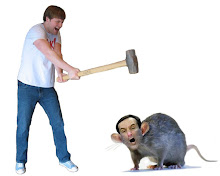
Left and right. Rational and Irrational.
I'm not sure why. But in my head this dichotomy is an epic – and hilarious – turf war.
On one side there’s a mild-mannered, grammatically-correct fellow I call Livingwell. He's a former fraternity executive board member. He holds doors open, pulls out chairs and has an insatiable affinity for Polo shirts. A true, humble gentleman of the South, that Livingwell.
Then there’s this other character, Livin’good. His energy level roughly equals 1.21 gigawatts. So pray he never finds a Dolorian with a functional flux capacitor. He throttles a Sonor drum kit. Runs in half marathons. Preserves the art of the mid-range jumper. And writes punchy. Choppy. Fragmenty. Sentences.
They're constantly at odds, you see. But nothing primes these two for civil strife like the creative process.
You see, Livingwell was a traffic manager. He thinks he knows exactly what kind of work clients tend to buy. Pragmatism is his muse. He’s level-headed. Practical.
Meanwhile Livin’good, artiste extraordinaire, is hell-bent on defying convention. For the sake of defying convention.
Fortunately, two years at the Creative Circus taught this duo a valuable lesson: there’s enough room in my brain for them both.
And once they realized they could coexist…well, the possibilities got much bigger.
Along with my ideas.
Tuesday, April 29, 2008

White Bread Rising, Chapter 1
To any Creative Directors, Creatives or lost souls who have navigated here, I sincerely appreciate it. Even if you clicked on the wrong link. Seriously.
Below is the first chapter of what I hope will be my first completed novel. Its working title is "White Bread Rising."
If I had to describe it in one sentence, I'd call it "A Confederacy of Dunces" set in North Carolina, c. 2005.
Enjoy.
The only thing that ever consoles man for the stupid things he does is the praise he always gives himself for doing them. – Oscar Wilde
Leaning over the granite kitchen countertop, Mrs. Hardeman leered at her husband the way a lioness might eye a three-legged zebra.
“No, Barry. This time you are going to have a chat with Harrison.”
Mr. Hardeman wasn’t used to seeing his pretty blonde wife so incensed. She didn’t protest when he came home late from work without explanation. Didn’t complain when he’d announce on a Thursday night he had to leave town on business that weekend. She never defied him, never asked questions, never raised the slightest objection.
But this wasn’t the slightest objection. This was the firmest demand.
“What do you want me to say, honey?” he said. “Tell me.”
“You’re supposed to be a Chief Operating Officer. Find a solution yourself.”
(Groan.) “Honey, this isn’t a corporation. This is our son.”
Courtesy of her non-prescription contact lenses, Mrs. Hardeman’s eyes narrowed to cobalt-tinted slits.
“That’s the problem, Barry. You could write the life story of every one of your employees. But you don’t have the first clue about your own child.”
(Sigh.) “Honey, how many time have we discussed this? When I got promoted, a transition period was inevitable.”
“You got promoted over a year ago. How much transition period could you possibly need?”
(Deep breath.) “Look. What do you want me to do?”
Mrs. Hardeman inched closer to her husband over the counter, rising to her tip-toes. Her body cast a faint shadow over the opened envelop that contained the 3rd quarter grade reports from Bradley Country Day School.
“All right,” she said. “From now on you can deal with the phone calls and emails from teachers saying he hasn’t turned in his homework. You can deal with the tantrums he throws if I take away his privileges. Let’s see how he reacts to you for a change.”
“Honey, you’re being irrational—”
“Studies have shown that nothing gets a child’s attention like a low-frequency, high decibel voice. You know, Barry? A man’s voice?”
“Oh, for God’s sake—”
“Then again, that means a man has to actually be around to discipline his child.”
Fine, he reasoned. Time to hoist the white flag, as much as it chagrined him.
“I’ll go talk to him,” Mr. Hardeman said, noting the smug satisfaction in his wife’s face. He dismissed it. For the time being.
“You said you spoke to him earlier?” he asked, walking to the second floor stairs.
“Yes,” Mrs. Hardeman replied, scowling.
“And?”
“And he barely acknowledged me.”
“I see.”
“Yeah. He was too busy listening to some rap song about sweat running off a guy’s balls.”
Mr. Hardeman recoiled and turned back around.
“What?”
“You heard me,” she said. “Why don’t you ask him about it?” And with that she walked off to their bedroom.
Barry Hardeman, M.B.A., Wharton School of Business ’84, returned his gaze ahead of him. He was patient, resourceful. The most dedicated, unflappable employee at the corporate office of Michaels & Sons Hardware. It was he who streamlined accounting with inhuman precision, without sacrificing accuracy. It was he, who had a sixth sense for detecting gaffes in inventory replenishment, swooping in like Superman before extraneous purchases were made. He was the sage, rational force that offset the immense temper and immense ineptitude of CEO/Chairman Mike Michaels III.
The only thing he couldn’t do, it seemed, was guide the direction of his son.
Mr. Hardeman conceded Harrison had exhibited some bizarre behavior since he started Middle School. Most peculiar was the boy’s fascination with what Newsweek described as “Hip Hop culture.” The oddest part was there wasn’t a single black kid in Harrison’s entire class. Come to think of it, Mr. Hardeman had never seen a single black kid at Country Day. Yet Harrison and his friends were compelled to imitate the dress of gun-toting street thugs. They boys had traded in their normal clothes for baggy gym shorts and jean shorts that hid their kneecaps and hung off their bony rear ends. Their shirts were two sizes too big, and the designer names of the shirts were emblazoned in huge letters across the front. NAUTICA or TOMMY HILFIGER could match the diameter of Harrison’s head. And of course, there was the music. When Harrison started buying rap CD’s, Mr. Hardeman, unlike his wife, hadn’t minded. Provided Harrison didn’t play it loud enough for anyone else in the house to hear, of course.
Talk about an idea that backfired. As he neared Harrison’s room, the sonic vibrations from the music’s bass penetrated Mr. Hardeman’s soul deeper than the Father, Son or Holy Ghost ever had.
Mr. Hardeman knocked on the bedroom door. No response.
He knocked again, this time much harder. Still no response, though he swore he could hear
Harrison’s voice amidst the background racket.
On the third try, Mr. Hardeman pounded as firmly as he could. The volume of the music decreased a few decibels.
“What?” Harrison called.
“Harrison, it’s your father.”
“Dad?”
“Yes. Please open the door.”
“Aaaight.”
Mr. Hardeman grimaced.
When Harrison didn’t come to the door immediately, Mr. Hardeman surmised his son was getting off the phone. Cell phone chatter had become Harrison’s preferred diversion, as evidenced by a $417 bill from Verizon this past month. Two hundred of that had been from text messages. Apparently it cost money to send and to receive them. His wife had left the bill in the study where she knew he’d find it, but Mr. Hardeman hadn’t gotten around to discussing it with Harrison just yet.
Finally, the door inched open.
Mr. Hardeman wondered if Harrison had misplaced his eighty-dollar Norelco shaver. That would at least explain why Harrison was sporting a shining peach-fuzz mustache, which his new crew cut accentuated. Mrs. Hardeman hated that hair style. Mr. Hardeman had defended it, saying it was more aerodynamic for playing sports. Now, as he stared at his son’s cropped blonde hair, he realized his wife had been right again, and him wrong. It was an unsavory trend.
“Can I come in?” Mr. Hardeman asked.
“Uh, sure,” Harrison replied, moving aside.
It had been a long time since Mr. Hardeman had looked around his son’s room. Adorning the walls were posters of rappers named Fidy Cent and Jay-Z. He also noticed a crudely drawn insignia taped to Harrison’s mirror. It appeared to be an interlocking “HH.” Mr. Hardeman mulled over it for a few seconds before its meaning dawned on him: Harrison Hardeman.
H-squared.
How Hilarious.
The same rap song was still thumping. Mr. Hardeman glanced at the premium B&K stereo setup he’d given his son for Christmas last year. Hearing it used this way chafed Barry Hardeman’s sensibilities like a mesh trucker’s hat worn in a five-star restaurant.
“Would you mind cutting off the music for a minute, Bud?”
Smacking his teeth in acrimony, Harrison hit the pause button. He then flopped down on his queen bed.
Mr. Hardeman pulled out Harrison’s desk chair and sat.
“How’s it going, Bud?”
“Fine.” Harrison said, not making eye contact.
“Your report card came in the mail today.”
Harrison rolled his eyes. “Mom told me.”
Mr. Hardeman crossed his legs and inhaled profoundly. “Bud, your grades have continued to get worse. I’ve tried to do some nice things to encourage you to try harder. But it seems the more I do for you, the less you try.”
Staring at the floor, Harrison shrugged his shoulders.
“Don’t you know that you might not get tracked into the advanced courses in high school? You want to go to a good college, don’t you?”
“I guess.”
Mr. Hardeman frowned. This child’s apathy was threatening the home-front equilibrium he’d enjoyed for so long. He and his wife had always operated under a tacit pact: You, honey, make the home while I, Barry, furnish it. She had no job, no stress-inducing obligations. No distractions.
(Except maybe her “Investment Club,” where once a month she and her gaggle of friends drank wine and gossiped about everything except the stock market.)
This arrangement had preserved the health of Barry Hardeman’s psyche, and the clearness of his conscience. Until now.
Mr. Hardeman tried to appear as sincere as possible. “Bud, are you mad at me?”
Harrison looked at his father, frowning.
“Nah, Dad. I ain’t mad at you.” (Ain’t mad atchoo.)
“Don’t say ain’t. It’s not a word.”
“My bad.”
“Listen, Bud…I know I haven’t been around as much as I should’ve been for the past year, but I—”
“Dad, you don’t havta ‘polagize, aaaight? You been workin’ late.”
“Mmm-hmm.”
“It’s no biggie.”
Mr. Hardeman’s livelihood was the extinguishing of white-collar fires. But it didn’t require his skill set to realize nothing he said or did now could whip his son into shape overnight. Reclaiming his son’s direction would be a protracted effort.
And as Barry Hardeman always solutions to his problems, this would be no different.
He slapped his thighs. “I’m glad you’re not disappointed in me, Bud. But starting right now, I want to play a bigger role in your life. You’re my only child and you deserve nothing less.”
For the first time, Harrison looked frightened.
“Dad, like I said, I don’t think you’re ignoring me. I don’t wanna cause you any trouble.”
Beaming, Mr. Hardeman rose from the desk chair. A few well-chosen words later, his son’s grammar was almost acceptable.
“Harrison, I guarantee you won’t cause me an ounce of trouble. You have your Dad’s word.” He walked over and gave his son a firm hug. Feebly, Harrison reciprocated.
“I’m looking forward to it, Bud. I really am,” Mr. Hardeman said. He left the room, Harrison looking more flustered than ever. The door closed behind him immediately.
This had turned out to be a productive afternoon. He could even enjoy a few extra hours of free time. He sat down in his living room recliner and turned the plasma screen to a golf tournament he’d TIVO’d.
Mrs. Hardeman heard the TV and left the master bedroom. The many pavéd diamonds of her engagement ring twinkled in the light as she entered.
“You talked to him, I take it?” she said. She seemed much calmer.
Mr. Hardeman flashed a broad smile. In all the years his wife had paid homage at the altar of Xanax, she’d never picked a better time to worship her favorite deity.
“Absolutely,” he replied. “And I’m confident he’s going to make some positive strides.”
Mrs. Hardeman was floored. Despite feeding him, clothing him and chauffeuring him – to school, soccer practices and friends’ houses – Harrison had pegged her as the tyrant of the house. Her sainted husband’s “buy something and go back to work” parenting method left her the honor of taking Harrison’s new things away. Her reward for being household turnkey was her son’s perpetual loathing.
No matter how sadistic it was, Mrs. Hardeman had hoped her own Victor Frankenstein would at last have to confront the Monster Brat he’d assembled.
“What did you two talk about?” she said.
“I told him I was concerned with his poor performance in school. And that I hadn’t paid him enough attention recently.”
“You said that?”
“I did indeed,” he replied. “And I told him I intend to get more involved in his life.”
She sat down on the sofa across from him. “You did?”
“I did indeed.”
“How did he react?”
Mr. Hardeman chuckled. “Honestly? He seemed a bit surprised.”
“Of course he’s surprised. You’ve been M.I.A. since you got promoted.”
“I know. And that’s going to change.”
Maybe it was his smile. Or the confidence he exuded so effortlessly, as if just breathing in his sleep…
Mrs. Hardeman walked over and squeezed her husband’s nearest hand.
“Barry, I don’t know what to say. I’m so…relieved.”
Mr. Hardeman patted the top of her hand, still smiling.
“Look honey, Els is teeing off.”
Mrs. Hardeman, too content sat back down on their plush leather sofa. She couldn’t remember feeling this optimistic in years, with or without pharmaceutical intervention.
“What’s the first thing you’re going to do with him?” she asked.
Mr. Hardeman flashed his infectious smile. “Just give me a day or two to think about it.”
Els’s shot went right down the center of the fairway.
Perfect form, Mr. Hardeman thought.
Chapter 1, part II
As much as he appreciated his position as Assistant Professor of History, Dr. Howard Peebles couldn’t help but feel the slightest twinge of exasperation toward his students.
This bitterness remained safely anonymous and unspecific. It was not outright contempt, or anything that extreme. Nor was it simply some hint of insecurity or envy that stemmed back to his modest upbringing. If that had been the case, he would have shrugged it off long ago, banishing it from the boundaries of his daily conscience. It was a lingering grudge, that’s all, not too benign or too harsh. He had learned to accept it as an intermittent nuisance he would just have to live with, and it would not detract from his career.
Walking through campus in a manner that showcased his bowlegged limbs, Dr. Peebles began making mental notes about what points to emphasize in his upcoming lecture. Nameless annoyances aside, he was passionate about teaching. A righteously progressive man, he believed all willing students – male and female, minority and status quo, fortunate and poor – had the right to reap the benefits of higher learning. His perspective would affect these young people in a variety of ways. Some would consider his course nothing more than a chore, and would discard every fact he’d taught them along with their final exam papers. A handful of others would listen and take notes attentively, but for no reason other than bolstering their chances of making an A.
But deep underneath lay a small number of students who would be uplifted by his accounts of history, in which he informed students of the way things really happened. He accomplished this feat without the aid of textbooks, which were about as reliable and objective as the Republicans who controlled the educational publishing companies. Students had the right to know the truth about history, and he took it upon himself to bring them the uncensored facts. If Dr. Peebles’s pupils chose not to accept the veracity of what he said, that was their prerogative. He had put forth his best effort to enlighten them.
He arrived at the main entrance of Harris Hall, which housed the History Department. The building’s very name was an affront to the university. F. Walker Harris, who served as university President during the Reconstruction era, had been a slave-owner before the Civil War. He was also rumored to hold ties to a local chapter of the Ku Klux Klan. While his links to the KKK remained unconfirmed, Harris had hardly been clandestine about bequeathing a large portion of his estate to the university. Part of this endowment had been used to build Harris Hall in his honor, complete with a bronze bust of the building’s namesake in the foyer. Dr. Peebles often swore he could see a tiny smirk on right corner of the statue’s lip. The old (alleged) bigot had found a foolproof way to preserve his legacy, and to hell with those who thought they could tarnish his reputation.
Dr. Peebles, who had long campaigned to have Harris Hall renamed, found himself wondering why none of the activist student groups on campus voiced stronger disapproval of the building.
As a faculty member without tenure, he could only protest so much before crossing a dangerous line with the administration’s bureaucracy. Students, however, were not encumbered by university politics and could say and do as they pleased. Oh, a number of students had picketed the building and drawn up petitions over the years. But these were only cursory gestures. None ever followed up these casual protests with anything significant.
He wondered if many of these students deemed the act of protesting as nothing more than a means to gain attention, an extracurricular diversion. If they truly wanted to make a difference, if they were genuinely offended, they should try harder. Much harder. But this inability to “take it up a notch” was typical of college students. They all had theories on how to change the world, but not the first inkling about how to bring these idealistic notions to fruition. Dr. Peebles did not begrudge his students for this shortcoming, however, and he was certain this flaw of theirs was not the cause of the small aggravation that plagued him. The callow mind of the average undergraduate could only grasp so much in four short years. And with more exciting social issues occurring around campus, he appreciated even the smallest considerations to the world at large.
The weather was unseasonably hot for mid-March, and Dr. Peebles wiped a few traces of perspiration from his exposed forehead as he walked indoors. Only a few wisps of light brown hair remained along his widow’s peak. Many men of his profession, and men in general, viewed baldness as a distinguished trait. Dr. Peebles dismissed this notion as sheer idiocy. Some of his erudite peers also believed in beards, another feature that had never appealed to Dr. Peebles. Believing one could augment their intelligence through physical features, he believed, was nothing more than foppish insecurity. Any fool could suffer from pattern baldness or grow facial hair. But how many people could complete a dissertation on Santa Anna’s underlying motives in the Gadsden Purchase?
Upon entering the classroom, Dr. Peebles remembered this was the first day of class after Spring Break. He was so active with local political groups and community outreach programs that concepts such as Spring Break didn’t apply to him. But it certainly applied to his students, and it didn’t take more than a prolonged glance or two around the classroom for him to identify the real party animals. Years of teaching undergrads had made Dr. Peebles all too familiar with the Greek System and its wannabee libertines.
Fortunately, their swilling of beer, harassment of young women and sporadic attendance of class would conclude after four years. Unfortunately, these boys’ fathers possessed a common paternal instinct: arranging lucrative jobs for their fortunate sons.
He did not view these particular individuals as students. Their “education” was little more than a four-year party, a formality before their rise to preordained prosperity. It was a modern-day aristocracy, a continuation of a flawed cycle that had survived for most of history. And who knew this truth better than a competent historian?
The clock reached eleven a.m. Dr. Peebles’s first thought was to announce a pop quiz on the seven pages of simple reading he’d assigned. But alas, even the most dedicated students were unlikely to crack a book over Spring Break. Also, experience had taught Dr. Peebles it was best not to jump directly into a lecture during the first class following a break. Better to provide a brief digression. This process, he felt, was similar to entering a cold swimming pool one step at a time, thus lessening the initial shock.
“Good morning,” Dr. Peebles said, smiling. “How was everyone’s break?”
A few murmurs echoed throughout the classroom, which contained about fifty to sixty students. The actual enrollment in the section was seventy-five.
At one time Dr. Peebles had passed around an attendance sheet at the beginning of class. But he’d found the sight (and smell) of hungover students bothered him far more than the thought of them blowing off class. Along with the unreliability of textbooks, this was why his exams pertained almost exclusively to lecture notes.
“Oh, come on. It had to be more eventful than that,” he said. “I tell you what. Let’s hear what some of you did over break. Who wants to volunteer?”
No single word drove fear into the hearts and souls of undergraduates more than volunteer. If no one volunteered, people got called on at random.
A few deafening, silent moments passed before a pleasant-looking brunette in the front row raised her hand. She’d been out to Colorado to visit her older sister. Dr. Peebles smiled.
After another brief lull, an alert-looking boy in the third row said he’d hiked part of the Appalachian Trail with his girlfriend. A redheaded girl then offered that she’d stayed in town and made some extra money working as a waitress. Again, Dr. Peebles beamed.
“Anyone else?” he said.
This time silence maintained a rigid grip on the classroom. Students peered from side to side, hoping someone else would have the audacity to give a five-second synopsis of their Spring Break. No one did.
“Well, looks like I’m going fishing,” Dr. Peebles said. Scanning the classroom, his eye caught a disheveled boy near the back whose dirty-blonde hair was tousled like a wavy, obtuse helmet. Through his bifocals Dr. Peebles could see the boy’s eyes, irritated and red.
“What about the young man near the back, with the bright yellow shirt?”
The boy in need of Visine looked shocked.
“Me?” he said. His tone was a mix of embarrassment and sleep deprivation.
“Yes sir,” Dr. Peebles replied. “We’d be honored to hear from you.”
“Uhhh,” Red-eyes said, as if speaking was heavy labor, “I went to Key West.”
“Ah. The Sunshine State, my old stomping ground,” Dr. Peebles said, ignoring his true sentiment. “What was happening in old Key West?”
The boy shrugged. “Not much. I hung out with friends, mostly.”
“Excellent! Spend lots of time on the beach, I assume?”
Yellow Shirt flushed.
“Essentially.”
“I see.” Dr. Peebles said.
(Essentially. Not content with deluging brain cells with Pabst Blue Ribbon, this boy had delusions of eloquence.)
“Well, I hope you had a time to remember,” Dr. Peebles said, putting a bit of emphasis on the final word of his sentence.
“Does anyone else care to volunteer?”
A few more reticent replies followed, after which Dr. Peebles decided it was time to get things moving. Today’s topic was one of his personal favorites: Abraham Lincoln’s rise to political prominence in Illinois.
And for the next sixty-eight minutes Dr. Howard Peebles praised, commended, lauded and extolled the virtues of the man who, after years of countless hardships, spearheaded the abolition of slavery. As he predicted, most students remained impassive, simply copying down his words like ambivalent stenographers. But there were a select number, including most of the section’s handful of black students, who hung on his every word. He honed in on their focuses like a smart missile developed guise of the Patriot Act.
“Do any of you think it strange that Lincoln described himself as pro-slavery when he entered local politics?” Dr. Peebles asked.
A young African-American student shot his hand into the air. Dr. Peebles acknowledged him.
“Yeah,” the student said. “Lincoln was a racist.”
Dr. Peebles smiled.
“It’s confusing, isn’t it?”
“Yeah,” the student said. “Everybody thinks Lincoln was this great man who freed the slaves and what-not.”
Satisfaction coursed through Dr. Peebles's moderately ample belly.
“You’ve just drawn attention to one of the things I think has always been terribly wrong with our country,” Dr. Peebles said. “The fact is, so many people are so backwards in their views that good men have to cater to their ignorance.
“Lincoln never supported the institution of slavery. He absolutely despised slavery. However, he knew that if he came out and denounced it for what is was, the people of Illinois would never back him for public office.”
The black student’s eyes lit up like the Rockefeller Square Christmas Tree.
“So Lincoln had to lie about liking slavery so people would vote for him.”
“Ex-actly.” Dr. Peebles said, feeling the familiar urge to transcend a lecture clawing at his conscience. He fought it for a brief moment, but its allure was too tempting…
“And the real tragedy, ladies and gentlemen, is that our country’s politics have only gotten more backwards with time. Take a look at our current president. When he’s not busy distracting people from his illegal war by denouncing gay marriage, his solution for improving our economy is to grant tax cuts to the wealthiest citizens in America! Now people born into poverty have even less hope of achieving upward mobility.”
A few satisfied mmm-hmm’s and uh-huh’s filled the air.
“How much of a chance do lower-class people really have?" Dr. Peebles said, his voice growing louder. "Too many public schools are in helplessly poor conditions. And the current funding provided by our government is embarrassingly inadequate.
“So, what becomes the most realistic means for these people to pursue wealth?”
Dr. Peebles waited. He could feel a trace of sweat on his brow.
At last, the brunette who visited her sister in Colorado spoke up in an uncertain voice.
“Crime?”
“Yes!” Dr. Peebles hadn’t felt so agitated since the Florida recount. “Conservative politicians love to talk tough on crime. Yet their imbalanced policies essentially
(he couldn’t help but glance back at Neon Yellow Shirt)
(who looked as apathetic and inattentive as ever)
create the very conditions that lead to crime.”
“And if someone like John Kerry talks about raising taxes, Republicans say he’s a huge liberal or something,” the black student added.
“That’s correct,” Dr. Peebles said disdainfully. “Liberal has essentially become a more acceptable way of saying communist. Or commie. Or pinko. Or whatever slander the right-wing spews our way. If you want to distract Joe American from the real issues at hand, just call someone a bleeding-heart lib-lab. Or preach about how gay marriage undermines the sanctity of the American family. Oh, give me a break…”
Dr. Peebles took a deep breath. Checking the clock on the wall, he saw it was 2:14. One last minute remained before class ended.
“I’ll leave you with this thought,” he said. “I hate crime as much as you all. I fear it every day. But for many people, resorting to crime often becomes preferable to living in squalor. Now, is that what our founding fathers had in mind when they guaranteed us the ability to pursue happiness? Or when they declared that all men were created equal?”
Dr. Peebles let his words sink in. The classroom’s silence was as thick as Florid-iot humidity.
“Until next time. Thank you all.”
The sounds of bookbags unzipping and notebooks being tossed around punctured the vacuum.
Dr. Peebles felt empowered. He was more than aware many of his students were Republicans by default. After all, most college students came from Upper-Middle Class and Upper-Class families, the Republican party’s lifeblood. But what he had said was undeniable, backed with impeccable logic and evidence. He might not convince them to change their political leanings, but he sure gave the conservative kids plenty to chew on.
Speaking of conservative kids, Neon Yellow Shirt had just filed into the row. Dr. Peebles observed him one last time, and when he did, the timeworn sensation of seeing someone familiar sprang into Dr. Peebles’s mind. To Dr. Peebles’s knowledge, he had never noticed this frat boy before today. But there was something about the boy’s face—maybe just one nameless aspect of it, maybe the whole thing—that struck a chord of familiarity in the professor’s mind. However, Dr. Peebles could not figure out who (or what) the kid resembled, and in a few seconds he and his Yellow Shirt were gone.
Dr. Peebles shook his head discreetly, packed up his things and headed off to the campus dining hall for lunch.
Below is the first chapter of what I hope will be my first completed novel. Its working title is "White Bread Rising."
If I had to describe it in one sentence, I'd call it "A Confederacy of Dunces" set in North Carolina, c. 2005.
Enjoy.
The only thing that ever consoles man for the stupid things he does is the praise he always gives himself for doing them. – Oscar Wilde
Leaning over the granite kitchen countertop, Mrs. Hardeman leered at her husband the way a lioness might eye a three-legged zebra.
“No, Barry. This time you are going to have a chat with Harrison.”
Mr. Hardeman wasn’t used to seeing his pretty blonde wife so incensed. She didn’t protest when he came home late from work without explanation. Didn’t complain when he’d announce on a Thursday night he had to leave town on business that weekend. She never defied him, never asked questions, never raised the slightest objection.
But this wasn’t the slightest objection. This was the firmest demand.
“What do you want me to say, honey?” he said. “Tell me.”
“You’re supposed to be a Chief Operating Officer. Find a solution yourself.”
(Groan.) “Honey, this isn’t a corporation. This is our son.”
Courtesy of her non-prescription contact lenses, Mrs. Hardeman’s eyes narrowed to cobalt-tinted slits.
“That’s the problem, Barry. You could write the life story of every one of your employees. But you don’t have the first clue about your own child.”
(Sigh.) “Honey, how many time have we discussed this? When I got promoted, a transition period was inevitable.”
“You got promoted over a year ago. How much transition period could you possibly need?”
(Deep breath.) “Look. What do you want me to do?”
Mrs. Hardeman inched closer to her husband over the counter, rising to her tip-toes. Her body cast a faint shadow over the opened envelop that contained the 3rd quarter grade reports from Bradley Country Day School.
“All right,” she said. “From now on you can deal with the phone calls and emails from teachers saying he hasn’t turned in his homework. You can deal with the tantrums he throws if I take away his privileges. Let’s see how he reacts to you for a change.”
“Honey, you’re being irrational—”
“Studies have shown that nothing gets a child’s attention like a low-frequency, high decibel voice. You know, Barry? A man’s voice?”
“Oh, for God’s sake—”
“Then again, that means a man has to actually be around to discipline his child.”
Fine, he reasoned. Time to hoist the white flag, as much as it chagrined him.
“I’ll go talk to him,” Mr. Hardeman said, noting the smug satisfaction in his wife’s face. He dismissed it. For the time being.
“You said you spoke to him earlier?” he asked, walking to the second floor stairs.
“Yes,” Mrs. Hardeman replied, scowling.
“And?”
“And he barely acknowledged me.”
“I see.”
“Yeah. He was too busy listening to some rap song about sweat running off a guy’s balls.”
Mr. Hardeman recoiled and turned back around.
“What?”
“You heard me,” she said. “Why don’t you ask him about it?” And with that she walked off to their bedroom.
Barry Hardeman, M.B.A., Wharton School of Business ’84, returned his gaze ahead of him. He was patient, resourceful. The most dedicated, unflappable employee at the corporate office of Michaels & Sons Hardware. It was he who streamlined accounting with inhuman precision, without sacrificing accuracy. It was he, who had a sixth sense for detecting gaffes in inventory replenishment, swooping in like Superman before extraneous purchases were made. He was the sage, rational force that offset the immense temper and immense ineptitude of CEO/Chairman Mike Michaels III.
The only thing he couldn’t do, it seemed, was guide the direction of his son.
Mr. Hardeman conceded Harrison had exhibited some bizarre behavior since he started Middle School. Most peculiar was the boy’s fascination with what Newsweek described as “Hip Hop culture.” The oddest part was there wasn’t a single black kid in Harrison’s entire class. Come to think of it, Mr. Hardeman had never seen a single black kid at Country Day. Yet Harrison and his friends were compelled to imitate the dress of gun-toting street thugs. They boys had traded in their normal clothes for baggy gym shorts and jean shorts that hid their kneecaps and hung off their bony rear ends. Their shirts were two sizes too big, and the designer names of the shirts were emblazoned in huge letters across the front. NAUTICA or TOMMY HILFIGER could match the diameter of Harrison’s head. And of course, there was the music. When Harrison started buying rap CD’s, Mr. Hardeman, unlike his wife, hadn’t minded. Provided Harrison didn’t play it loud enough for anyone else in the house to hear, of course.
Talk about an idea that backfired. As he neared Harrison’s room, the sonic vibrations from the music’s bass penetrated Mr. Hardeman’s soul deeper than the Father, Son or Holy Ghost ever had.
Mr. Hardeman knocked on the bedroom door. No response.
He knocked again, this time much harder. Still no response, though he swore he could hear
Harrison’s voice amidst the background racket.
On the third try, Mr. Hardeman pounded as firmly as he could. The volume of the music decreased a few decibels.
“What?” Harrison called.
“Harrison, it’s your father.”
“Dad?”
“Yes. Please open the door.”
“Aaaight.”
Mr. Hardeman grimaced.
When Harrison didn’t come to the door immediately, Mr. Hardeman surmised his son was getting off the phone. Cell phone chatter had become Harrison’s preferred diversion, as evidenced by a $417 bill from Verizon this past month. Two hundred of that had been from text messages. Apparently it cost money to send and to receive them. His wife had left the bill in the study where she knew he’d find it, but Mr. Hardeman hadn’t gotten around to discussing it with Harrison just yet.
Finally, the door inched open.
Mr. Hardeman wondered if Harrison had misplaced his eighty-dollar Norelco shaver. That would at least explain why Harrison was sporting a shining peach-fuzz mustache, which his new crew cut accentuated. Mrs. Hardeman hated that hair style. Mr. Hardeman had defended it, saying it was more aerodynamic for playing sports. Now, as he stared at his son’s cropped blonde hair, he realized his wife had been right again, and him wrong. It was an unsavory trend.
“Can I come in?” Mr. Hardeman asked.
“Uh, sure,” Harrison replied, moving aside.
It had been a long time since Mr. Hardeman had looked around his son’s room. Adorning the walls were posters of rappers named Fidy Cent and Jay-Z. He also noticed a crudely drawn insignia taped to Harrison’s mirror. It appeared to be an interlocking “HH.” Mr. Hardeman mulled over it for a few seconds before its meaning dawned on him: Harrison Hardeman.
H-squared.
How Hilarious.
The same rap song was still thumping. Mr. Hardeman glanced at the premium B&K stereo setup he’d given his son for Christmas last year. Hearing it used this way chafed Barry Hardeman’s sensibilities like a mesh trucker’s hat worn in a five-star restaurant.
“Would you mind cutting off the music for a minute, Bud?”
Smacking his teeth in acrimony, Harrison hit the pause button. He then flopped down on his queen bed.
Mr. Hardeman pulled out Harrison’s desk chair and sat.
“How’s it going, Bud?”
“Fine.” Harrison said, not making eye contact.
“Your report card came in the mail today.”
Harrison rolled his eyes. “Mom told me.”
Mr. Hardeman crossed his legs and inhaled profoundly. “Bud, your grades have continued to get worse. I’ve tried to do some nice things to encourage you to try harder. But it seems the more I do for you, the less you try.”
Staring at the floor, Harrison shrugged his shoulders.
“Don’t you know that you might not get tracked into the advanced courses in high school? You want to go to a good college, don’t you?”
“I guess.”
Mr. Hardeman frowned. This child’s apathy was threatening the home-front equilibrium he’d enjoyed for so long. He and his wife had always operated under a tacit pact: You, honey, make the home while I, Barry, furnish it. She had no job, no stress-inducing obligations. No distractions.
(Except maybe her “Investment Club,” where once a month she and her gaggle of friends drank wine and gossiped about everything except the stock market.)
This arrangement had preserved the health of Barry Hardeman’s psyche, and the clearness of his conscience. Until now.
Mr. Hardeman tried to appear as sincere as possible. “Bud, are you mad at me?”
Harrison looked at his father, frowning.
“Nah, Dad. I ain’t mad at you.” (Ain’t mad atchoo.)
“Don’t say ain’t. It’s not a word.”
“My bad.”
“Listen, Bud…I know I haven’t been around as much as I should’ve been for the past year, but I—”
“Dad, you don’t havta ‘polagize, aaaight? You been workin’ late.”
“Mmm-hmm.”
“It’s no biggie.”
Mr. Hardeman’s livelihood was the extinguishing of white-collar fires. But it didn’t require his skill set to realize nothing he said or did now could whip his son into shape overnight. Reclaiming his son’s direction would be a protracted effort.
And as Barry Hardeman always solutions to his problems, this would be no different.
He slapped his thighs. “I’m glad you’re not disappointed in me, Bud. But starting right now, I want to play a bigger role in your life. You’re my only child and you deserve nothing less.”
For the first time, Harrison looked frightened.
“Dad, like I said, I don’t think you’re ignoring me. I don’t wanna cause you any trouble.”
Beaming, Mr. Hardeman rose from the desk chair. A few well-chosen words later, his son’s grammar was almost acceptable.
“Harrison, I guarantee you won’t cause me an ounce of trouble. You have your Dad’s word.” He walked over and gave his son a firm hug. Feebly, Harrison reciprocated.
“I’m looking forward to it, Bud. I really am,” Mr. Hardeman said. He left the room, Harrison looking more flustered than ever. The door closed behind him immediately.
This had turned out to be a productive afternoon. He could even enjoy a few extra hours of free time. He sat down in his living room recliner and turned the plasma screen to a golf tournament he’d TIVO’d.
Mrs. Hardeman heard the TV and left the master bedroom. The many pavéd diamonds of her engagement ring twinkled in the light as she entered.
“You talked to him, I take it?” she said. She seemed much calmer.
Mr. Hardeman flashed a broad smile. In all the years his wife had paid homage at the altar of Xanax, she’d never picked a better time to worship her favorite deity.
“Absolutely,” he replied. “And I’m confident he’s going to make some positive strides.”
Mrs. Hardeman was floored. Despite feeding him, clothing him and chauffeuring him – to school, soccer practices and friends’ houses – Harrison had pegged her as the tyrant of the house. Her sainted husband’s “buy something and go back to work” parenting method left her the honor of taking Harrison’s new things away. Her reward for being household turnkey was her son’s perpetual loathing.
No matter how sadistic it was, Mrs. Hardeman had hoped her own Victor Frankenstein would at last have to confront the Monster Brat he’d assembled.
“What did you two talk about?” she said.
“I told him I was concerned with his poor performance in school. And that I hadn’t paid him enough attention recently.”
“You said that?”
“I did indeed,” he replied. “And I told him I intend to get more involved in his life.”
She sat down on the sofa across from him. “You did?”
“I did indeed.”
“How did he react?”
Mr. Hardeman chuckled. “Honestly? He seemed a bit surprised.”
“Of course he’s surprised. You’ve been M.I.A. since you got promoted.”
“I know. And that’s going to change.”
Maybe it was his smile. Or the confidence he exuded so effortlessly, as if just breathing in his sleep…
Mrs. Hardeman walked over and squeezed her husband’s nearest hand.
“Barry, I don’t know what to say. I’m so…relieved.”
Mr. Hardeman patted the top of her hand, still smiling.
“Look honey, Els is teeing off.”
Mrs. Hardeman, too content sat back down on their plush leather sofa. She couldn’t remember feeling this optimistic in years, with or without pharmaceutical intervention.
“What’s the first thing you’re going to do with him?” she asked.
Mr. Hardeman flashed his infectious smile. “Just give me a day or two to think about it.”
Els’s shot went right down the center of the fairway.
Perfect form, Mr. Hardeman thought.
Chapter 1, part II
As much as he appreciated his position as Assistant Professor of History, Dr. Howard Peebles couldn’t help but feel the slightest twinge of exasperation toward his students.
This bitterness remained safely anonymous and unspecific. It was not outright contempt, or anything that extreme. Nor was it simply some hint of insecurity or envy that stemmed back to his modest upbringing. If that had been the case, he would have shrugged it off long ago, banishing it from the boundaries of his daily conscience. It was a lingering grudge, that’s all, not too benign or too harsh. He had learned to accept it as an intermittent nuisance he would just have to live with, and it would not detract from his career.
Walking through campus in a manner that showcased his bowlegged limbs, Dr. Peebles began making mental notes about what points to emphasize in his upcoming lecture. Nameless annoyances aside, he was passionate about teaching. A righteously progressive man, he believed all willing students – male and female, minority and status quo, fortunate and poor – had the right to reap the benefits of higher learning. His perspective would affect these young people in a variety of ways. Some would consider his course nothing more than a chore, and would discard every fact he’d taught them along with their final exam papers. A handful of others would listen and take notes attentively, but for no reason other than bolstering their chances of making an A.
But deep underneath lay a small number of students who would be uplifted by his accounts of history, in which he informed students of the way things really happened. He accomplished this feat without the aid of textbooks, which were about as reliable and objective as the Republicans who controlled the educational publishing companies. Students had the right to know the truth about history, and he took it upon himself to bring them the uncensored facts. If Dr. Peebles’s pupils chose not to accept the veracity of what he said, that was their prerogative. He had put forth his best effort to enlighten them.
He arrived at the main entrance of Harris Hall, which housed the History Department. The building’s very name was an affront to the university. F. Walker Harris, who served as university President during the Reconstruction era, had been a slave-owner before the Civil War. He was also rumored to hold ties to a local chapter of the Ku Klux Klan. While his links to the KKK remained unconfirmed, Harris had hardly been clandestine about bequeathing a large portion of his estate to the university. Part of this endowment had been used to build Harris Hall in his honor, complete with a bronze bust of the building’s namesake in the foyer. Dr. Peebles often swore he could see a tiny smirk on right corner of the statue’s lip. The old (alleged) bigot had found a foolproof way to preserve his legacy, and to hell with those who thought they could tarnish his reputation.
Dr. Peebles, who had long campaigned to have Harris Hall renamed, found himself wondering why none of the activist student groups on campus voiced stronger disapproval of the building.
As a faculty member without tenure, he could only protest so much before crossing a dangerous line with the administration’s bureaucracy. Students, however, were not encumbered by university politics and could say and do as they pleased. Oh, a number of students had picketed the building and drawn up petitions over the years. But these were only cursory gestures. None ever followed up these casual protests with anything significant.
He wondered if many of these students deemed the act of protesting as nothing more than a means to gain attention, an extracurricular diversion. If they truly wanted to make a difference, if they were genuinely offended, they should try harder. Much harder. But this inability to “take it up a notch” was typical of college students. They all had theories on how to change the world, but not the first inkling about how to bring these idealistic notions to fruition. Dr. Peebles did not begrudge his students for this shortcoming, however, and he was certain this flaw of theirs was not the cause of the small aggravation that plagued him. The callow mind of the average undergraduate could only grasp so much in four short years. And with more exciting social issues occurring around campus, he appreciated even the smallest considerations to the world at large.
The weather was unseasonably hot for mid-March, and Dr. Peebles wiped a few traces of perspiration from his exposed forehead as he walked indoors. Only a few wisps of light brown hair remained along his widow’s peak. Many men of his profession, and men in general, viewed baldness as a distinguished trait. Dr. Peebles dismissed this notion as sheer idiocy. Some of his erudite peers also believed in beards, another feature that had never appealed to Dr. Peebles. Believing one could augment their intelligence through physical features, he believed, was nothing more than foppish insecurity. Any fool could suffer from pattern baldness or grow facial hair. But how many people could complete a dissertation on Santa Anna’s underlying motives in the Gadsden Purchase?
Upon entering the classroom, Dr. Peebles remembered this was the first day of class after Spring Break. He was so active with local political groups and community outreach programs that concepts such as Spring Break didn’t apply to him. But it certainly applied to his students, and it didn’t take more than a prolonged glance or two around the classroom for him to identify the real party animals. Years of teaching undergrads had made Dr. Peebles all too familiar with the Greek System and its wannabee libertines.
Fortunately, their swilling of beer, harassment of young women and sporadic attendance of class would conclude after four years. Unfortunately, these boys’ fathers possessed a common paternal instinct: arranging lucrative jobs for their fortunate sons.
He did not view these particular individuals as students. Their “education” was little more than a four-year party, a formality before their rise to preordained prosperity. It was a modern-day aristocracy, a continuation of a flawed cycle that had survived for most of history. And who knew this truth better than a competent historian?
The clock reached eleven a.m. Dr. Peebles’s first thought was to announce a pop quiz on the seven pages of simple reading he’d assigned. But alas, even the most dedicated students were unlikely to crack a book over Spring Break. Also, experience had taught Dr. Peebles it was best not to jump directly into a lecture during the first class following a break. Better to provide a brief digression. This process, he felt, was similar to entering a cold swimming pool one step at a time, thus lessening the initial shock.
“Good morning,” Dr. Peebles said, smiling. “How was everyone’s break?”
A few murmurs echoed throughout the classroom, which contained about fifty to sixty students. The actual enrollment in the section was seventy-five.
At one time Dr. Peebles had passed around an attendance sheet at the beginning of class. But he’d found the sight (and smell) of hungover students bothered him far more than the thought of them blowing off class. Along with the unreliability of textbooks, this was why his exams pertained almost exclusively to lecture notes.
“Oh, come on. It had to be more eventful than that,” he said. “I tell you what. Let’s hear what some of you did over break. Who wants to volunteer?”
No single word drove fear into the hearts and souls of undergraduates more than volunteer. If no one volunteered, people got called on at random.
A few deafening, silent moments passed before a pleasant-looking brunette in the front row raised her hand. She’d been out to Colorado to visit her older sister. Dr. Peebles smiled.
After another brief lull, an alert-looking boy in the third row said he’d hiked part of the Appalachian Trail with his girlfriend. A redheaded girl then offered that she’d stayed in town and made some extra money working as a waitress. Again, Dr. Peebles beamed.
“Anyone else?” he said.
This time silence maintained a rigid grip on the classroom. Students peered from side to side, hoping someone else would have the audacity to give a five-second synopsis of their Spring Break. No one did.
“Well, looks like I’m going fishing,” Dr. Peebles said. Scanning the classroom, his eye caught a disheveled boy near the back whose dirty-blonde hair was tousled like a wavy, obtuse helmet. Through his bifocals Dr. Peebles could see the boy’s eyes, irritated and red.
“What about the young man near the back, with the bright yellow shirt?”
The boy in need of Visine looked shocked.
“Me?” he said. His tone was a mix of embarrassment and sleep deprivation.
“Yes sir,” Dr. Peebles replied. “We’d be honored to hear from you.”
“Uhhh,” Red-eyes said, as if speaking was heavy labor, “I went to Key West.”
“Ah. The Sunshine State, my old stomping ground,” Dr. Peebles said, ignoring his true sentiment. “What was happening in old Key West?”
The boy shrugged. “Not much. I hung out with friends, mostly.”
“Excellent! Spend lots of time on the beach, I assume?”
Yellow Shirt flushed.
“Essentially.”
“I see.” Dr. Peebles said.
(Essentially. Not content with deluging brain cells with Pabst Blue Ribbon, this boy had delusions of eloquence.)
“Well, I hope you had a time to remember,” Dr. Peebles said, putting a bit of emphasis on the final word of his sentence.
“Does anyone else care to volunteer?”
A few more reticent replies followed, after which Dr. Peebles decided it was time to get things moving. Today’s topic was one of his personal favorites: Abraham Lincoln’s rise to political prominence in Illinois.
And for the next sixty-eight minutes Dr. Howard Peebles praised, commended, lauded and extolled the virtues of the man who, after years of countless hardships, spearheaded the abolition of slavery. As he predicted, most students remained impassive, simply copying down his words like ambivalent stenographers. But there were a select number, including most of the section’s handful of black students, who hung on his every word. He honed in on their focuses like a smart missile developed guise of the Patriot Act.
“Do any of you think it strange that Lincoln described himself as pro-slavery when he entered local politics?” Dr. Peebles asked.
A young African-American student shot his hand into the air. Dr. Peebles acknowledged him.
“Yeah,” the student said. “Lincoln was a racist.”
Dr. Peebles smiled.
“It’s confusing, isn’t it?”
“Yeah,” the student said. “Everybody thinks Lincoln was this great man who freed the slaves and what-not.”
Satisfaction coursed through Dr. Peebles's moderately ample belly.
“You’ve just drawn attention to one of the things I think has always been terribly wrong with our country,” Dr. Peebles said. “The fact is, so many people are so backwards in their views that good men have to cater to their ignorance.
“Lincoln never supported the institution of slavery. He absolutely despised slavery. However, he knew that if he came out and denounced it for what is was, the people of Illinois would never back him for public office.”
The black student’s eyes lit up like the Rockefeller Square Christmas Tree.
“So Lincoln had to lie about liking slavery so people would vote for him.”
“Ex-actly.” Dr. Peebles said, feeling the familiar urge to transcend a lecture clawing at his conscience. He fought it for a brief moment, but its allure was too tempting…
“And the real tragedy, ladies and gentlemen, is that our country’s politics have only gotten more backwards with time. Take a look at our current president. When he’s not busy distracting people from his illegal war by denouncing gay marriage, his solution for improving our economy is to grant tax cuts to the wealthiest citizens in America! Now people born into poverty have even less hope of achieving upward mobility.”
A few satisfied mmm-hmm’s and uh-huh’s filled the air.
“How much of a chance do lower-class people really have?" Dr. Peebles said, his voice growing louder. "Too many public schools are in helplessly poor conditions. And the current funding provided by our government is embarrassingly inadequate.
“So, what becomes the most realistic means for these people to pursue wealth?”
Dr. Peebles waited. He could feel a trace of sweat on his brow.
At last, the brunette who visited her sister in Colorado spoke up in an uncertain voice.
“Crime?”
“Yes!” Dr. Peebles hadn’t felt so agitated since the Florida recount. “Conservative politicians love to talk tough on crime. Yet their imbalanced policies essentially
(he couldn’t help but glance back at Neon Yellow Shirt)
(who looked as apathetic and inattentive as ever)
create the very conditions that lead to crime.”
“And if someone like John Kerry talks about raising taxes, Republicans say he’s a huge liberal or something,” the black student added.
“That’s correct,” Dr. Peebles said disdainfully. “Liberal has essentially become a more acceptable way of saying communist. Or commie. Or pinko. Or whatever slander the right-wing spews our way. If you want to distract Joe American from the real issues at hand, just call someone a bleeding-heart lib-lab. Or preach about how gay marriage undermines the sanctity of the American family. Oh, give me a break…”
Dr. Peebles took a deep breath. Checking the clock on the wall, he saw it was 2:14. One last minute remained before class ended.
“I’ll leave you with this thought,” he said. “I hate crime as much as you all. I fear it every day. But for many people, resorting to crime often becomes preferable to living in squalor. Now, is that what our founding fathers had in mind when they guaranteed us the ability to pursue happiness? Or when they declared that all men were created equal?”
Dr. Peebles let his words sink in. The classroom’s silence was as thick as Florid-iot humidity.
“Until next time. Thank you all.”
The sounds of bookbags unzipping and notebooks being tossed around punctured the vacuum.
Dr. Peebles felt empowered. He was more than aware many of his students were Republicans by default. After all, most college students came from Upper-Middle Class and Upper-Class families, the Republican party’s lifeblood. But what he had said was undeniable, backed with impeccable logic and evidence. He might not convince them to change their political leanings, but he sure gave the conservative kids plenty to chew on.
Speaking of conservative kids, Neon Yellow Shirt had just filed into the row. Dr. Peebles observed him one last time, and when he did, the timeworn sensation of seeing someone familiar sprang into Dr. Peebles’s mind. To Dr. Peebles’s knowledge, he had never noticed this frat boy before today. But there was something about the boy’s face—maybe just one nameless aspect of it, maybe the whole thing—that struck a chord of familiarity in the professor’s mind. However, Dr. Peebles could not figure out who (or what) the kid resembled, and in a few seconds he and his Yellow Shirt were gone.
Dr. Peebles shook his head discreetly, packed up his things and headed off to the campus dining hall for lunch.
Subscribe to:
Posts (Atom)